
Introduction
Window frame leaks are among the most frustrating home issues in Singapore’s humid, rain-heavy environment. One moment, you’re enjoying the afternoon breeze — the next, water seeps in along the sill after a tropical downpour.
Unlike roof or ceiling leaks, window frame seepage often hides in plain sight. It may appear as a small puddle, slight bubbling paint, or dampness near the frame corners. But beneath that surface, it can signal deeper problems: failed sealant, clogged weep holes, or missing drip edges that no longer deflect rain effectively.
This article explains how to identify the root cause, the common “hotspots” around window frames, and how professionals in Singapore diagnose and repair them properly.
Singapore Context: Why Windows Leak So Easily Here
In Singapore, heavy rain rarely falls straight down. The combination of strong crosswinds, driving rain, and high humidity makes window joints vulnerable. Even well-installed windows age faster under these tropical conditions.
Older HDB and condo units often rely on silicone sealant applied decades ago. Over time, this sealant shrinks, hardens, or separates from the concrete surface. During storms, wind pressure pushes rainwater into these tiny gaps — and gravity does the rest.
Newer developments may use aluminium or uPVC window frames with integrated weep holes and drip edges, but poor maintenance or incorrect sealing can still block drainage paths.
Why Window Frame Seepage Matters
A little dampness might seem harmless, but window seepage can cause far-reaching problems:
- Wall blistering and bubbling paint, especially near corners.
- Black mould growth due to trapped humidity.
- Damage to wooden flooring or built-in cabinets below the window.
- Corrosion of metal frames or window fasteners.
- Weakened structural joints in extreme cases.
In high-rise flats, leaks can also pose safety concerns — falling plaster, damaged electrical fittings, or loose window fasteners.
Three Key Components: Sealant, Drip Edge, and Weep Holes
To understand why window seepage occurs, you need to know how these three parts work together to protect your home.
1. Sealant – The First Line of Defence
The sealant fills gaps between the window frame and wall, preventing rain from entering. Over time, exposure to sunlight and rain causes it to crack or detach.
Common sealant issues:
- Hard, brittle, or peeling silicone.
- Gaps forming along vertical edges or sill corners.
- Overpainting that traps moisture behind the sealant.
Quick test: Spray water on the window edges; if water seeps through within minutes, the sealant has likely failed.
2. Drip Edge – Redirecting Rainwater Away
A drip edge (or drip groove) is a small channel designed to deflect rainwater away from the window’s underside. Without it, water clings to the frame via surface tension and seeps back toward the wall.
Signs of drip edge problems:
- Water streaks running down the wall below the window.
- Damp stains forming even when the window is closed.
- Poorly designed or missing drip groove beneath the sill.
Many older flats lack proper drip edges entirely, relying only on sealant — a shortcut that rarely lasts in tropical storms.
3. Weep Holes – The Hidden Drainage Path
Weep holes are small openings at the bottom of the window frame that let water drain out. When these holes clog with dust or paint, water pools inside the frame and eventually spills indoors.
How to spot the issue:
- No visible weep holes under the outer sill.
- Water dripping inside even when the rain is mild.
- Stagnant water or rust marks along the inner sill.
Regular cleaning or vacuuming of these holes prevents many window leaks before they start.
Common Window Leak Scenarios in Singapore Homes
| Scenario | Likely Cause | Typical Location |
|---|---|---|
| Water seeping from window corners | Failed sealant | Side or bottom frame corners |
| Puddle forming on sill during rain | Blocked weep holes | Bottom rail of frame |
| Water stains below window sill | Missing drip edge | Wall under frame |
| Water entering from closed window | Wind-driven rain through gaps | Window hinge or slider |
| Recurrent mould near window base | Trapped moisture | Behind paint or frame seal |
Step-by-Step: Professional Leak Inspection Process
Specialists like LEAK Works use systematic methods to locate the true entry point of window leaks — especially when the signs appear far from the actual source.
| Step | Method | Description |
|---|---|---|
| 1 | Visual Survey | Examine exterior walls, sealant lines, and sill slopes for cracks or gaps. |
| 2 | Water Spray Simulation | Controlled spraying mimics storm conditions to trace seepage. |
| 3 | Infrared Thermography | Detects temperature differences where moisture collects. |
| 4 | Endoscopic Inspection | Mini camera inserted along joints to locate hidden cracks. |
| 5 | Dye Testing | Non-toxic coloured dye reveals leak pathways through wall cavities. |
| 6 | Moisture Mapping | Quantifies the spread of dampness across interior surfaces. |
The goal: confirm whether the leak stems from sealant deterioration, blocked drainage, or design flaws before applying any repair solution.
DIY Checks Before Calling a Specialist
You can perform some simple checks to narrow down the issue:
- Inspect sealant condition — look for cracks, peeling, or missing sections.
- Check weep holes — use a toothpick or cotton bud to clear visible debris.
- Simulate rain — spray water from outside (if accessible) and watch for seepage.
- Use a flashlight — shine it along sill corners to detect hidden damp spots.
- Listen — during rain, a faint dripping sound inside the frame often indicates trapped water.
If the leak persists after these checks, professional testing is worth the call — especially for high-rise units where access and safety matter.
Professional Repair Solutions
Depending on findings, leak specialists apply one or more of the following methods:
| Method | Description | Advantage |
|---|---|---|
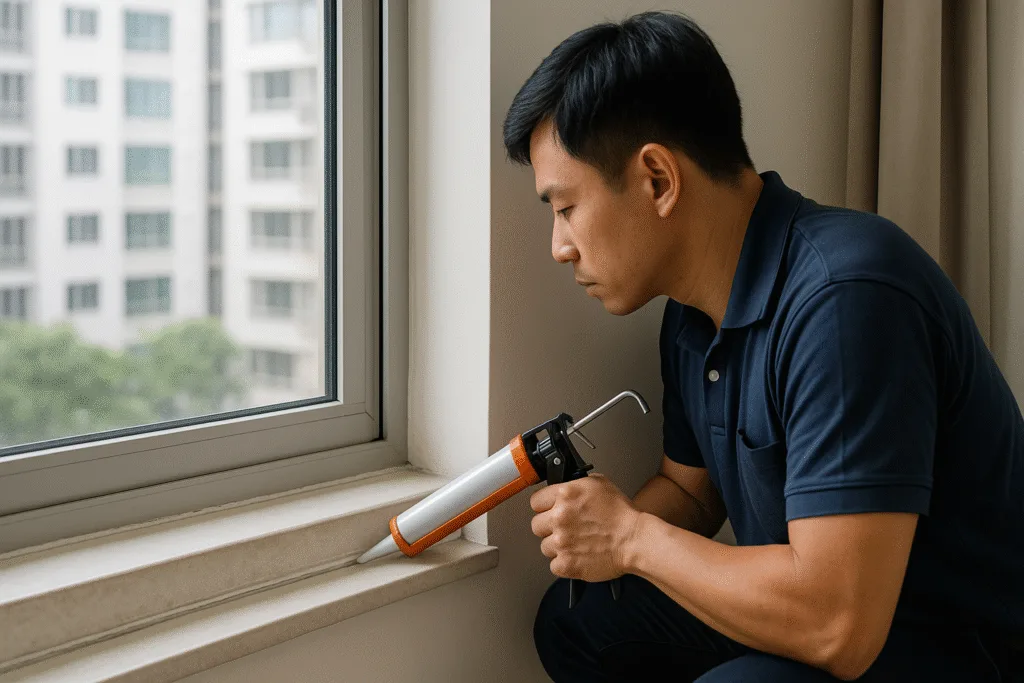
| Sealant Renewal | Remove and replace all aged or cracked silicone along window perimeter. | Restores watertight barrier quickly. |
| Weep Hole Cleaning / Recutting | Clear or recreate drainage holes at base of frame. | Ensures proper water outflow. |
| Drip Edge Installation | Add or re-profile groove beneath sill to direct rain outward. | Prevents future backflow. |
| Joint Re-grouting / PU Injection | Seal structural cracks within the wall or frame joint. | Handles deeper seepage sources. |
| Protective Coating | Apply clear waterproof film to exterior wall or sill. | Extra layer of defence for older units. |
Professional-grade sealants used in Singapore are typically UV-resistant silicones or polyurethane-based hybrids — far more durable than retail-grade options.
Typical Repair Costs in Singapore
| Service | Price Range (SGD) | Remarks |
|---|---|---|
| Leak detection & diagnostic test | $150 – $300 | Includes report and moisture mapping. |
| Full perimeter sealant renewal | $250 – $600 | Depends on window size and height. |
| Weep hole cleaning & restoration | $100 – $250 | Often bundled with inspection. |
| Drip edge installation | $200 – $500 | For older sills without grooves. |
| PU crack injection | $400 – $900 | For deep structural seepage. |
For older properties, combining sealant renewal + weep hole service usually resolves most leaks under $800 total.
Signs It’s Time to Act
Delaying window leak repairs can cause bigger issues later. Pay attention to:
- Paint blistering around the frame or sill.
- Dark, damp patches that reappear after rain.
- Mould or musty smell near the window base.
- Corroded metal fittings or loose handles.
- Persistent dampness even after re-caulking once.
In Singapore’s humidity, trapped moisture can spread fast — prevention beats repeated repainting.
Health and Comfort Considerations
Mould from window leaks isn’t just an eyesore; it can irritate skin, throat, and respiratory systems, especially for children or the elderly. Damp interiors also attract dust mites and insects.
A dry, sealed window makes the indoor climate more comfortable and improves air conditioning efficiency — no more musty smells or peeling walls.
DIY vs Professional Fix: A Comparison
| Option | Works Best For | Lifespan | Caution |
|---|---|---|---|
| DIY Silicone Reseal | Small visible cracks. | 6–12 months | Often fails if old sealant not fully removed. |
| Professional Reseal | Multiple or deep cracks. | 5–10 years | Higher upfront cost, better durability. |
| Drip Edge Addition | Old units lacking groove. | Permanent | Needs skilled alignment. |
| Weep Hole Cleaning | Routine maintenance. | Ongoing | Easy to do yearly. |
Even the best DIY job won’t fix a blocked drainage channel hidden inside the frame. Professionals have the tools to test from both inside and outside safely.
Preventive Maintenance Tips
- Inspect sealant yearly for cracks or gaps.
- Clean window frames monthly, including weep holes.
- Avoid overpainting sealant lines — it can trap water.
- Check drip edges during exterior cleaning.
- Schedule inspection every 8–10 years, especially before major renovation.
In Singapore’s climate, a little regular care goes a long way toward avoiding costly water damage.
FAQs
1. How do I know if my window leak is from rain or condensation?
Condensation forms when indoor humidity meets cold glass, often in air-conditioned rooms. Seepage, on the other hand, usually occurs during or right after rain and involves visible dripping.
2. Can I just apply new sealant over the old one?
No. Old sealant must be removed completely for proper adhesion; layering new over old rarely lasts.
3. What sealant is best for window waterproofing?
Use neutral-cure silicone or PU hybrid types designed for outdoor use and UV resistance.
4. What are weep holes, and how many should I have?
They’re small drain openings at the window’s base — typically 2–3 per frame section, depending on width.
5. How often should I service or re-caulk my windows?
Every 5–8 years, or sooner if you see cracks or peeling.
6. My new condo still leaks — why?
Installation gaps, missing drip grooves, or poor sealing during construction are common. Request inspection during the defect liability period.
7. Can water leaks cause window frame corrosion?
Yes, prolonged seepage corrodes aluminium or steel frames and loosens structural joints over time.
Conclusion
In Singapore’s tropical climate, window frame seepage is a silent but serious problem. Whether it stems from failing sealant, missing drip edges, or blocked weep holes, the key is proper diagnosis before you seal anything shut.
Professional inspection by teams like LEAK Works ensures the root cause is treated — not just the symptom. From detailed leak detection to precision resealing and drip-edge retrofits, these methods restore both protection and peace of mind.
A watertight window isn’t just about keeping the rain out — it’s about keeping your home strong, dry, and comfortable for years to come.
发表回复