
Introduction
In Singapore’s humid, rain-prone climate, waterproofing tests are essential for ensuring buildings remain dry and structurally sound. Whether you are dealing with a newly installed roof membrane, a re-sealed bathroom, or a suspected leak in a concrete balcony, the right test method determines how accurately issues are identified and resolved. Among the most common techniques, the spray test and the water ponding test stand out for their simplicity and effectiveness — but they serve very different purposes.
This guide explains both tests in detail, highlights their differences, and helps you decide which one is best suited for your property or project.
Singapore Context
In Singapore, where average annual rainfall exceeds 2,300 mm and sudden downpours are common, water infiltration can occur in both high-rise and landed properties. Many buildings here feature flat roofs, open balconies, and concealed plumbing systems — all of which are vulnerable to leaks over time due to thermal movement and waterproofing fatigue.
Facilities managers and homeowners often face similar challenges: distinguishing whether a leak comes from surface cracks, failed membranes, or internal water seepage. Tests like spray and ponding are standard tools in local BCA-compliant waterproofing inspections and are often used during pre-handover checks for new developments.
Why It Matters
Leaks don’t just stain ceilings; they weaken concrete, corrode steel reinforcement, and invite mould growth. Left untreated, moisture intrusion can damage electrical fittings, reduce property value, and disrupt business operations.
Conducting accurate waterproofing tests early prevents costly repairs and helps contractors verify that their waterproofing systems perform as promised under real-world conditions.
Types of Waterproofing Tests
Waterproofing integrity tests typically fall into three main categories:
| Test Type | Description | Typical Areas |
|---|---|---|
| Spray Test | Simulates rain by spraying water on targeted surfaces | Facades, windows, walls, doors |
| Water Ponding Test | Involves pooling water to test membrane integrity | Roofs, balconies, toilets |
| Flood or Hydrostatic Test | Uses controlled filling to check drainage and waterproofing simultaneously | Bathrooms, planter boxes, concrete slabs |
This article focuses on the first two — spray test vs ponding test — and how to choose between them.
Understanding the Spray Test
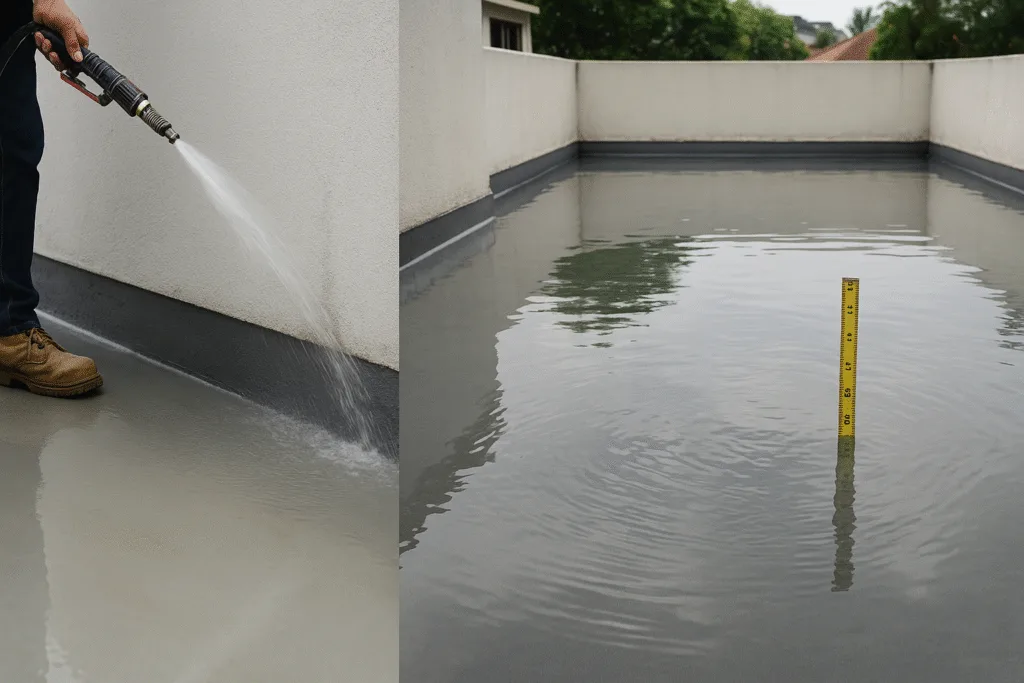
The spray test (sometimes called a “rain simulation test”) involves spraying water under controlled conditions on a specific area to detect leaks through external facades, windows, or junctions.
How It Works
- Preparation: The area is cleaned and visually inspected for visible cracks or gaps.
- Setup: A calibrated nozzle sprays water at a defined pressure and flow rate, often per ASTM E1105 or Singapore’s SS 525 standards.
- Spraying: Water is directed at joints, seals, or surfaces for 15–30 minutes.
- Observation: Inspectors observe interior walls for any moisture penetration.
- Reporting: Moisture entry points are marked and photographed for documentation.
When to Use a Spray Test
- To check the performance of window frames, curtain walls, or external facades.
- When investigating wind-driven rain leaks.
- For non-horizontal surfaces where water doesn’t naturally pool.
- During BCA TOP (Temporary Occupation Permit) inspections to verify façade integrity.
Pros and Cons
Advantages:
- Quick and non-destructive.
- Simulates actual rain conditions.
- Ideal for pinpointing external water entry points.
Limitations:
- Ineffective for roofs or ponded areas.
- Results can vary depending on wind and spray angle.
- Doesn’t reveal membrane failures beneath tiles or coatings.
Understanding the Water Ponding Test
The water ponding test, also known as the “flood test,” is designed to verify the integrity of horizontal waterproofing systems. It involves flooding a contained area with water for a fixed period to observe any seepage.
How It Works
- Preparation: All outlets are temporarily sealed.
- Filling: The area (such as a roof, balcony, or toilet floor) is filled with water, usually 25–50 mm deep.
- Observation Period: The water level is monitored for 24–72 hours.
- Inspection: Inspectors check the underside (e.g., ceiling below) for damp patches or drips.
- Reporting: If no leakage is detected, the waterproofing membrane is deemed intact.
When to Use a Ponding Test
- To verify newly installed waterproof membranes on flat roofs or wet areas.
- After repair or resealing works.
- For horizontal or slightly sloped surfaces.
- As part of handover testing in both residential and commercial projects.
Pros and Cons
Advantages:
- Detects even small membrane breaches.
- Confirms waterproofing performance under prolonged exposure.
- Straightforward and cost-effective.
Limitations:
- Requires downtime (area must remain flooded).
- Not suitable for vertical or porous finishes.
- Can’t isolate the exact point of leakage once found.
Spray Test vs Water Ponding Test: Key Differences
| Feature | Spray Test | Water Ponding Test |
|---|---|---|
| Surface Type | Vertical | Horizontal |
| Simulates | Rainfall | Standing water |
| Duration | Short (15–30 mins) | Long (24–72 hrs) |
| Detection Type | Surface penetration | Membrane breach |
| Applications | Facades, windows | Roofs, toilets, balconies |
| Test Equipment | Spray nozzle, pump | Hose, water gauge |
| Result Accuracy | Immediate visual | Time-based seepage |
| Risk | Minimal | Moderate (weight load, water exposure) |
Step-by-Step Example: Roof Leak Diagnosis in Singapore
Let’s say a homeowner in Tampines reports water marks on their bedroom ceiling. The waterproofing specialist from Leak Works conducts an initial inspection and suspects the roof membrane.
- A water ponding test is performed on the rooftop, flooding the area for 48 hours.
- After 24 hours, moisture appears on the ceiling below — confirming a breach.
- The technician marks the affected area and uses infrared thermography to trace the exact path.
- Once repairs are completed, a follow-up ponding test verifies the leak is resolved.
In contrast, if the issue had been water seeping through a window joint, a spray test would have been the proper diagnostic choice.
DIY vs Professional Testing
While some homeowners attempt DIY leak tests, professional assessment remains the gold standard for accuracy and safety.
| Aspect | DIY | Professional |
|---|---|---|
| Equipment | Basic hose or bucket | Calibrated spray system / water gauge |
| Risk Management | Low control | Trained to prevent overflow or damage |
| Documentation | None | Official report with photos |
| Accuracy | Inconsistent | Verified per industry standards |
Professional leak testing from Leak Works ensures compliance with BCA guidelines and prevents unnecessary rework. They also use moisture meters and infrared imaging to complement both spray and ponding tests.
Signs You May Need a Test
You might require either a spray or ponding test if you notice:
- Damp spots or peeling paint on ceilings.
- Mould growth near windows or balconies.
- Water stains after heavy rain.
- Persistent odour of dampness.
- Discoloration on wall corners or ceilings.
- Cracked tile grout in wet areas.
In Singapore’s tropical climate, these signs can escalate quickly — early testing saves both money and stress.
Health, Efficiency & Lifestyle Benefits
Leak detection tests aren’t just about aesthetics. Preventing moisture ingress:
- Reduces mould-related respiratory risks.
- Keeps indoor humidity stable and comfortable.
- Preserves structural integrity of concrete.
- Avoids damage to furnishings and electronics.
- Extends waterproofing lifespan by detecting early wear.
Cost & Frequency in Singapore
Pricing varies depending on area size, access difficulty, and test type.
- Spray Test: From S$200–S$400 per façade section.
- Water Ponding Test: Around S$250–S$600 for standard toilets or balconies; large roofs can range from S$800–S$1,200.
Many property owners schedule waterproofing inspections every 3–5 years, especially after renovation works or before property handover.
Key Benefits Summary
| Benefit | Spray Test | Water Ponding Test |
|---|---|---|
| Ideal for | Vertical leaks | Horizontal leaks |
| Duration | Quick (minutes) | Long (days) |
| Damage Risk | Very low | Moderate |
| Leak Confirmation | Immediate | Time-based |
| Singapore Use Case | Façade testing | Roof & toilet inspection |
FAQ
1. Can a spray test and ponding test be done together?
Yes. Many professionals combine both for comprehensive leak detection — spray for vertical surfaces, ponding for flat areas.
2. How long should a ponding test run?
Typically 24–72 hours, depending on project requirements and waterproofing specifications.
3. Will a ponding test damage my tiles or floor?
No, if done correctly. Only weak membranes or poor workmanship would allow leakage.
4. Is it safe to perform these tests in high-rise units?
Yes, but it must be supervised by licensed professionals familiar with BCA safety protocols.
5. How soon can I retest after repairs?
Wait at least 24 hours for materials to cure before performing a re-test.
6. How accurate are infrared scans compared to these tests?
Infrared scans help locate moisture but can’t confirm waterproofing integrity like ponding or spray tests can.
7. Can rain substitute for a spray test?
No. Natural rain is inconsistent and cannot replicate controlled test conditions.
Conclusion
Both spray tests and water ponding tests are indispensable tools in Singapore’s waterproofing industry. Knowing when to use each prevents misdiagnosis and ensures your property stays leak-free even through the heaviest monsoon downpours.
If you’re unsure which method suits your situation, professional teams like Leak Works can evaluate your property and recommend the most effective testing plan — whether you’re verifying a new waterproofing membrane or diagnosing a stubborn leak.
发表回复